Quick answer: GEICO has one of the lowest consumer complaint ratios among major NYC auto insurers — 0.0074 for GEICO General and 0.0143 for GEICO Indemnity, per 2025 NY Department of Financial Services data.
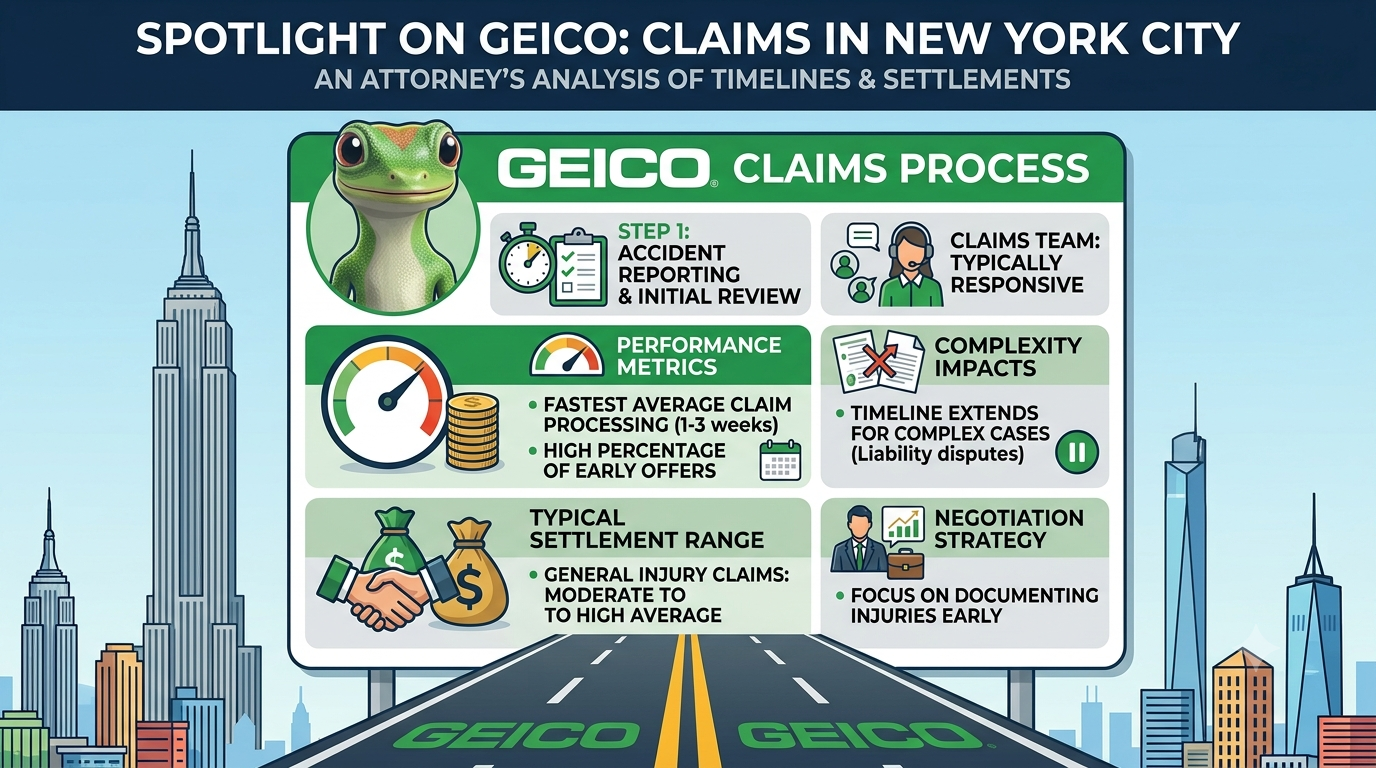
GEICO’s New York claims handling is moderate-paced relative to other carriers. Early offers on soft tissue cases tend to run low.
Funding implication: neutral. GEICO’s timeline does not meaningfully shorten or extend expected case duration.
If you were hit by a GEICO policyholder in New York City, the regulatory record gives you something most plaintiffs never get: an objective, state-published measure of how that company actually performs on consumer complaints — not marketing copy, not anecdote.
What the New York State Data Shows
The New York Department of Financial Services (DFS) publishes an annual ranking of auto insurers by upheld consumer complaints per $1 million of premiums written. It is the only independent, state-verified measure of insurer claims conduct available to the public — not a law firm’s marketing claim, not a funder’s sales pitch.
In the 2025 ranking (complaints closed in 2024), GEICO’s New York entities performed as follows:
| GEICO Entity | Complaint Ratio | Rank (of 128) | Total Complaints |
|---|---|---|---|
| GEICO General Insurance Company | 0.0074 | 49th | 458 |
| Government Employees Insurance Co. | 0.0081 | 51st | 139 |
| GEICO Indemnity Company | 0.0143 | 56th | 262 |
Source: NY Department of Financial Services, 2025 Automobile Insurance Complaint Ranking Report (complaints closed in 2024). Lower ratio = fewer upheld complaints per $1M in premiums written.
For context, the statewide average across all 128 ranked entities was 0.0341. GEICO’s entities are meaningfully below that average — among the better performers on this specific metric, though not the single best (several smaller insurers with low claim volume occupy the top ranks).
What This Means for Your Timeline
A low complaint ratio is not the same as a fast settlement. It measures whether DFS found GEICO’s claims decisions inappropriate often enough to generate upheld regulatory complaints — not how quickly GEICO moves to resolve a case, and not what GEICO offers early in negotiation.
GEICO is the highest-volume private passenger auto insurer operating in New York. That volume creates large adjuster caseloads, and large caseloads tend to produce one consistent pattern across the industry: early settlement offers — particularly on soft tissue and moderate-injury claims — are calibrated to test whether a plaintiff needs cash before the full extent of damages is documented. This is standard claims-handling practice, not specific to GEICO, but it’s worth naming because it directly affects whether early funding makes sense in a GEICO case.
On surgical and high-severity injury claims, the gap between GEICO’s opening offer and eventual settlement value tends to widen — which is the pattern across the industry generally, not unique to this carrier.
Funding Considerations in a GEICO Case
GEICO’s regulatory performance and moderate claims pace make it a neutral factor in pre-settlement funding underwriting — it neither accelerates nor materially extends the expected timeline relative to other major carriers operating in NYC. Venue, liability strength, and injury severity remain the larger drivers of how long a case takes and what funding terms make economic sense.
Run your numbers: the JUSTLAW estimator factors carrier, venue, and injury type together to project a timeline range and funding eligibility score specific to your case — not a generic industry average.
A Note on Source Data
The complaint ratios above come directly from the New York DFS’s published annual report and reflect upheld complaints only — meaning DFS independently agreed the insurer made an inappropriate decision. Complaints that were withdrawn or not upheld are excluded. This data does not measure settlement speed, settlement value, or litigation posture, and should be read as one input among several, not a complete picture of how GEICO will handle any individual case.